Another great find from the stacks of the Minneapolis Central Public Library is a magazine called Chemical Week.
The ’70s graphic design elements are fun (check out the hand and spray-gun from the Hercules Chemicals ad—can anyone tell me: what is the name of that style and why is it so ubiquitous in mid-seventies illustration?), and the copy is fun too. This is mainly because the short and punchy nature of mid-century ad lingo is constantly fighting against the highly technical, multisyllabic jargon of industrial chemistry. The results are headlines like this:
Many of our customers needed a surfactant that would be stable and compatible in formulations with high alkalai concentrations and at the same time be biodegradable.
The tagline to the ad is this: “We even originated the word surfactant.”
The full image set is posted here.

Howdy, all–I’ll be pimpin’ wares at Zinefest again this year. Stop by my table and say hi!
Here’s the lowdown:
Where: Powderhorn Park building
3400 15th Avenue S.
Minneapolis, MN 55407
When: Saturday, Sept. 24, 2011, 12 – 5 pm.
More info: http://zinefest.org
I’ll have my old books for sale plus the latest issue of Deep City on hand, samples of which can be found below. Happy trails, dear reader.


From Walt Whitman’s “Specimen Days”—
Probably another point, too, how we give long preparations for some object, planning and delving and fashioning, and then, when the actual hour for doing arrives, find ourselves still quite unprepared, and tumble the thing together, letting hurry and crudeness tell the story better than fine work.
Which does not end well. As told in Trickster Makes This World, by the most excellent Lewis Hyde.


There’s some fine and noble scavengers out there on the web––junk seekers with an eye for beauty. Some of our personal favorites include Draplin Design (file under “Vintage,” and “Extra-Tuff”) and Marc Fischer’s amazing archival project, Public Collectors. And the online lit-mag DIAGRAM, true to its name, features vintage and obscure diagrams in every issue alongside its poetry and prose.
New Carriage isn’t immune from the junk bug… so please enjoy our small contribution––the first set of which can be found on flickr––and we’ll promise to post more discoveries in the meantime. Cheers to all you junkers out there.

Completely thrilled be a part of this great reading series next Thursday, 5/6, alongside a bunch of quality poets. Come, drink wine, relax in the confines of beautiful Rogue Buddha Gallery, soak up the spoken word, and catch a free film in the process! (Yes, “How to Live Better” lives on!) Your Thursday is hereby planned.
Thursday, May 6, 2010
7:00pm – 9:00pm
Rogue Buddha Gallery
357 13th Ave. Nordeast
Minneapolis, MN
Thursday, May 6, 2010
7:00pm – 9:00pm
Rogue Buddha Gallery
357 13th Ave. Nordeast
Minneapolis, MN

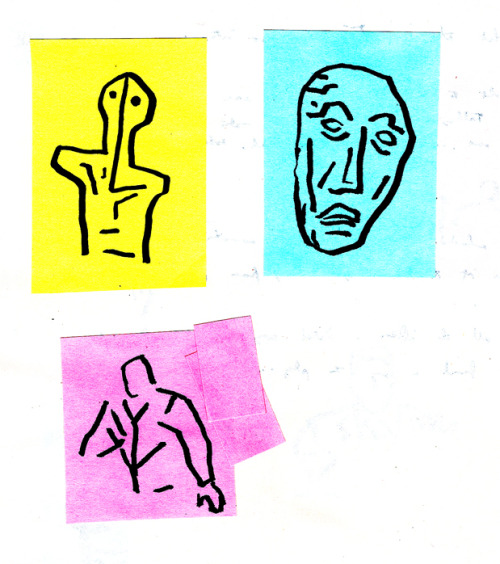
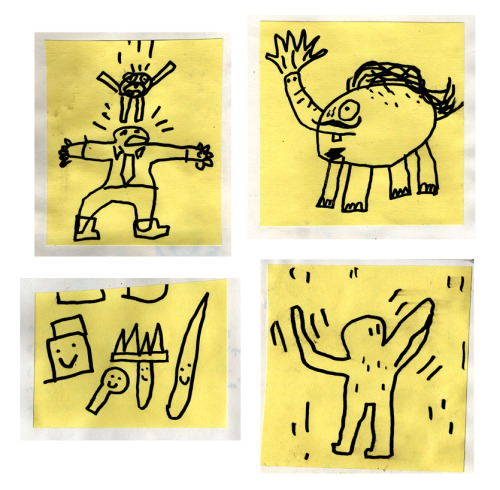
Item of interest: Children Draw and Tell: an Introduction to the Projective Uses of Children’s Human Figure Drawings. By Marvin Klepsch and Laura Logie. New York: Brunnel / Mazel, 1982.
Observation (of item): CDaT, as advertised in the title, is filled with psychological analyses of children’s drawings, almost all of which are unfailingly blunt: ”… motor problems…” “… in need of security and support…” “… terror of nurse and/or needle…” “… feels intellectually inadequate…” “Overall Impression: Insignificance, shyness, smallness….”
A selection of digitized images from the item: they can be found here on the New Carriage photostream.
Observation (of self): The above causes me to think: (a) “This is completely sad and heartbreaking.” (b) “I’m thinking of my own son right now, hoping to keep him from harm.” (c) “I don’t even want to consider the complications of this, I just want to love him, that’s all.” (d) “It’s sad enough that small children face the entire range of adult emotional anxieties, but why does it also seem sadder that children’s drawings ‘leak out’ their innermost feelings, and that these drawings can then be examined clinically?” And, subsequently: (e) “Why should that bother me?”
Additional, barely-related thoughts: (a) “I wonder how often innermost feelings leak out of adults?” (b) “Maybe a lot. Or maybe very infrequently. It’s probably hard to tell and depends on the person anyway.” (c) “Personally, I had to lose a lot of poker hands before I realized that, for me, the answer is: ‘a lot.’”
Sequence of observations and excerpts (random, of item):
- children’s pictoral depictions of human beings (either of themselves or others) are significant enough in the world of psychology to rate a special term: Human Figure Drawings. They can also be called HFDs.
- HFDs (according to CDaT) first attracted attention from psychologists in the early 1900s. Since then, the study of HFDs has yielded many different kinds of psychological tests, all with special names: (1) the “Goodenough-Harris Draw-a-Man Test”; (2) the “House-Tree-Person Test” (Koppitz, 1968); (3) the “Gesell Incomplete Man Test”; (4) the “Evanston Early Identification Scale” (EEIS); and (5) one part of the “Denver Developmental Screening Test.”
- “A three-year-old typically draws a person as a head…” (14).
- “Four-year-olds make tadpole-like drawings…” (14).
- “At five years of age, most children will draw a body and a head. The head will contain eyes, a nose, and a mouth, and arms and legs will emanate from the body” (14).

Promotional blurb on back of a VHS case for the movie Sodom and Gomorrah. (Found at: video & seminar room, Salvation Army Adult Rehabilitation Center, Minneapolis, Minnesota.)
Sodom and Gomorrah. Two cities built on barbarous cruelty and ruled by unspeakable vice. Sweeping off the pages of the bible, and brought to life by a cast of thousands, this breathtaking, epic production paints a vivid and shocking portrait of the cities too wicked and sinful to survive. It’s the story of Lot (Stuart Granger) who led the Hebrews out of the desert to these twin cities of sin, and into temptations no man or woman could resist. From bloody battle and sadistic torture to savage passion, it’s an action-packed story of shameless corruption of the flesh and spirit that leads to an awesome climax, as God’s fury is unleashed in one of the most gripping cinematic sequences of destruction ever created. Directed by Robert Aldrich in 1963, the star-studded international ensemble features Anouk Ami and Pierre Angelli. One hundred forty eight minutes, color, nineteen sixty three.

From Drinking and Intoxication, edited by Raymond G. McCarthy; The Free Press; Glencoe, Illinois: 1959.
Much interesting work was done on [drunkenness] in the 19th century, and quaint theories persisted even then. Robert McNish, a member of the College of Physicians and Surgeons of Glasgow, in 1835 in a book Anatomy of Drunkenness, discussed the peculiar phenomenon of spontaneous combustion of drunkards, a condition which, he claims, is well documented and in which the whole body, starting with the viscera, is burned in a few hours by a combustive process which for some reason does not even singe the surrounding furniture.
From Advanced Techniques of Hypnosis, by Melvin Powers, 1973.

More here….