Archive for the ‘Images’ Category

Children Draw and Tell

Monday, April 19th, 2010

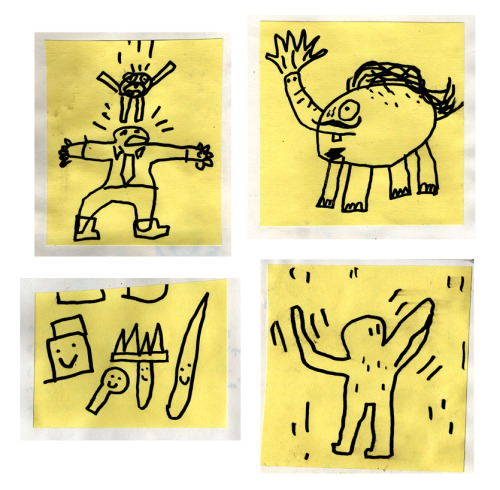
cdat-1

Item of interest: Children Draw and Tell: an Introduction to the Projective Uses of Children’s Human Figure Drawings. By Marvin Klepsch and Laura Logie. New York: Brunnel / Mazel, 1982.

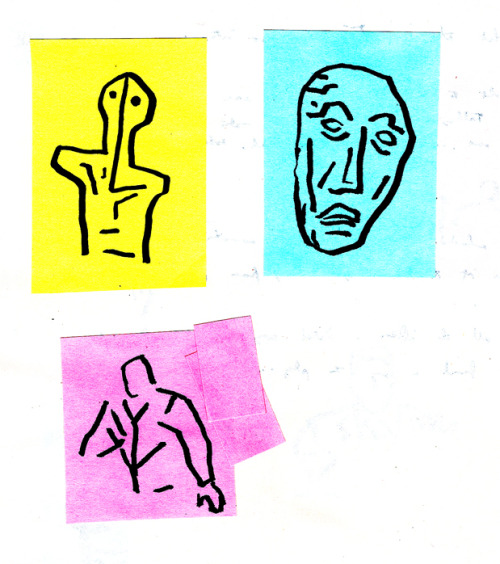
Observation (of item): CDaT, as advertised in the title, is filled with psychological analyses of children’s drawings, almost all of which are unfailingly blunt: ”… motor problems…” “… in need of security and support…” “… terror of nurse and/or needle…” “… feels intellectually inadequate…” “Overall Impression: Insignificance, shyness, smallness….”

A selection of digitized images from the item: they can be found here on the New Carriage photostream.

Observation (of self): The above causes me to think: (a) “This is completely sad and heartbreaking.” (b) “I’m thinking of my own son right now, hoping to keep him from harm.” (c) “I don’t even want to consider the complications of this, I just want to love him, that’s all.” (d) “It’s sad enough that small children face the entire range of adult emotional anxieties, but why does it also seem sadder that children’s drawings ‘leak out’ their innermost feelings, and that these drawings can then be examined clinically?” And, subsequently: (e) “Why should that bother me?”

Additional, barely-related thoughts: (a) “I wonder how often innermost feelings leak out of adults?” (b) “Maybe a lot. Or maybe very infrequently. It’s probably hard to tell and depends on the person anyway.” (c) “Personally, I had to lose a lot of poker hands before I realized that, for me, the answer is: ‘a lot.’”

Sequence of observations and excerpts (random, of item):

  • children’s pictoral depictions of human beings (either of themselves or others) are significant enough in the world of psychology to rate a special term: Human Figure Drawings. They can also be called HFDs.
  • HFDs (according to CDaT) first attracted attention from psychologists in the early 1900s. Since then, the study of HFDs has yielded many different kinds of psychological tests, all with special names: (1) the “Goodenough-Harris Draw-a-Man Test”; (2) the “House-Tree-Person Test” (Koppitz, 1968); (3) the “Gesell Incomplete Man Test”; (4) the “Evanston Early Identification Scale” (EEIS); and (5) one part of the “Denver Developmental Screening Test.”
  • “A three-year-old typically draws a person as a head…” (14).
  • “Four-year-olds make tadpole-like drawings…” (14).
  • “At five years of age, most children will draw a body and a head. The head will contain eyes, a nose, and a mouth, and arms and legs will emanate from the body” (14).

Advanced Techniques of Hypnosis

Wednesday, February 3rd, 2010

From Advanced Techniques of Hypnosis, by Melvin Powers, 1973.

hypnosis-bp

More here….

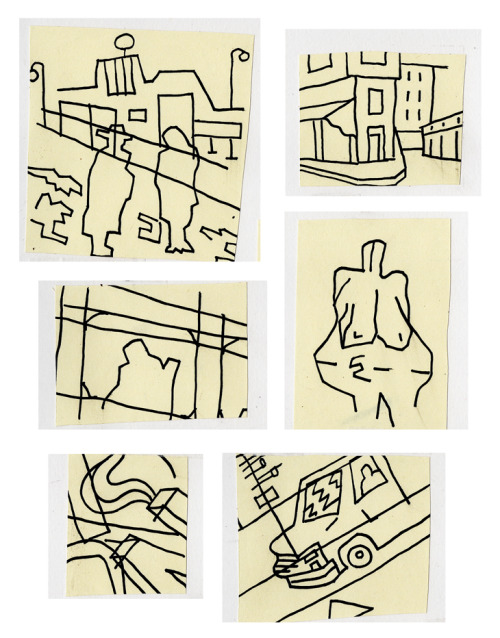
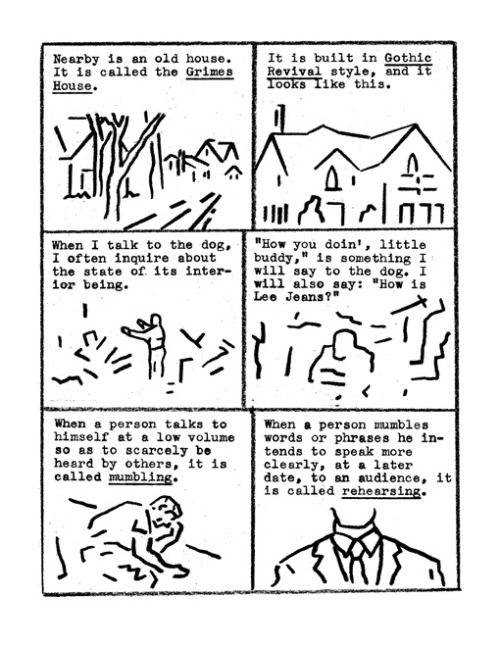
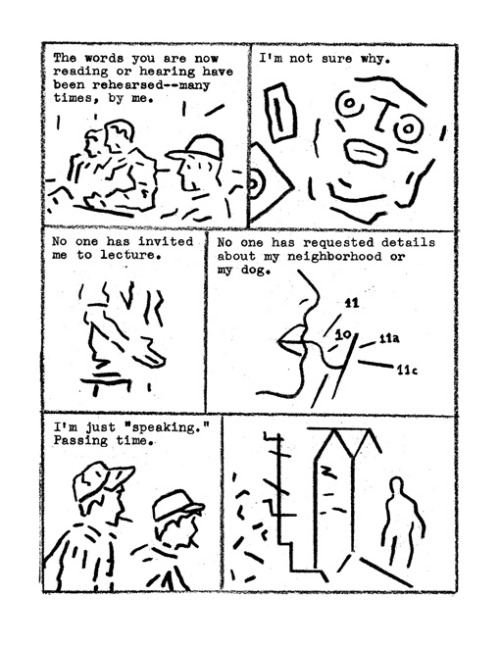
Three postcards for winter

Tuesday, January 5th, 2010

gr_float

mli_float

comics_float

Draft of an Advertisement for a Robot

Monday, October 12th, 2009

kind_robot-2

Seeing Wrongly

Friday, October 2nd, 2009

Dear Art-maker –

I was thinking about some of the problems you outlined in your  manifesto — “Nobody listens to me”; “I’ve lost the power to grip the minds and hearts of the public,” etc. — and they are bummers. I am being as honest as I can when I say that I feel your pain.

But maybe your poem, novel or surrealist dream-theater belongs outside of the gallery. What I’m saying is that maybe there’s room for a genuine art experience — a spark ignited in the mind of a single viewer — that occurs in the world of commercial circulars and coupons.

I am enclosing an excerpt from September’s “Angie’s Mailbag,” from the consumer-reviews aggregator Angie’s List. “Susan T.” writes:

mailbag4

The type of artwork mentioned above looks like this:

angieslist5

I am going to put on hold the fact that I think this might represent a real artistic triumph — the working artist, through the medium of a consumer publication devoted to reviewing house-painters and plumbers, unwittingly sends a message to a woman in Texas, and that message explodes in her brain like a nightmare — and am instead going to take this time to reflect a little about distortion.

If you are Susan T., you want to hire a plumber who looks like an adult human plumber. He should not “look like a fetus” or have “boneless rope-arms.” But I keep coming back to an axiom, probably flawed, that the more a work of art expresses its uniqueness, the more it will seem broken, wrong or distorted.

Furthermore: this is a good thing.

(As an aside, doesn’t the Angie’s List plumber seem like — that famous distortion — a Giacometti shadow?)

Notable Unique Artists hired to perform commercial work are often hired expressly for this skill — the ability to see wrongly — and I’m reminded of the Errol Morris commercials where a man’s head is framed out in favor of his blue-collar gut, or where the “natural subjects” of a rooftop party — attractive young people drinking alcohol — are instead seen in fragments or partially obscured by a chunk of steel.

I worked on a website once where a client balked at using generic photographs (ubiquitous) of well-dressed business people. The smiles and sartorial sharpness and non-insanity of the people, she said, was itself disturbing and unreal.

In any case we should be thanking Susan T. of Dallas. I can’t share her view, but who’s to say she didn’t have her fill that day of signal-disruption and expressionistic interrogation. Sometimes we want to know the world.

Which brings me to these last items of internet curiosity: Iconoclastic Artists Making Commercials. (David Lynch and the Coen brothers.) Which is wholly different from artists appearing in commercials. (Joseph Beuys and Andy Warhol.)

All best,
M.